
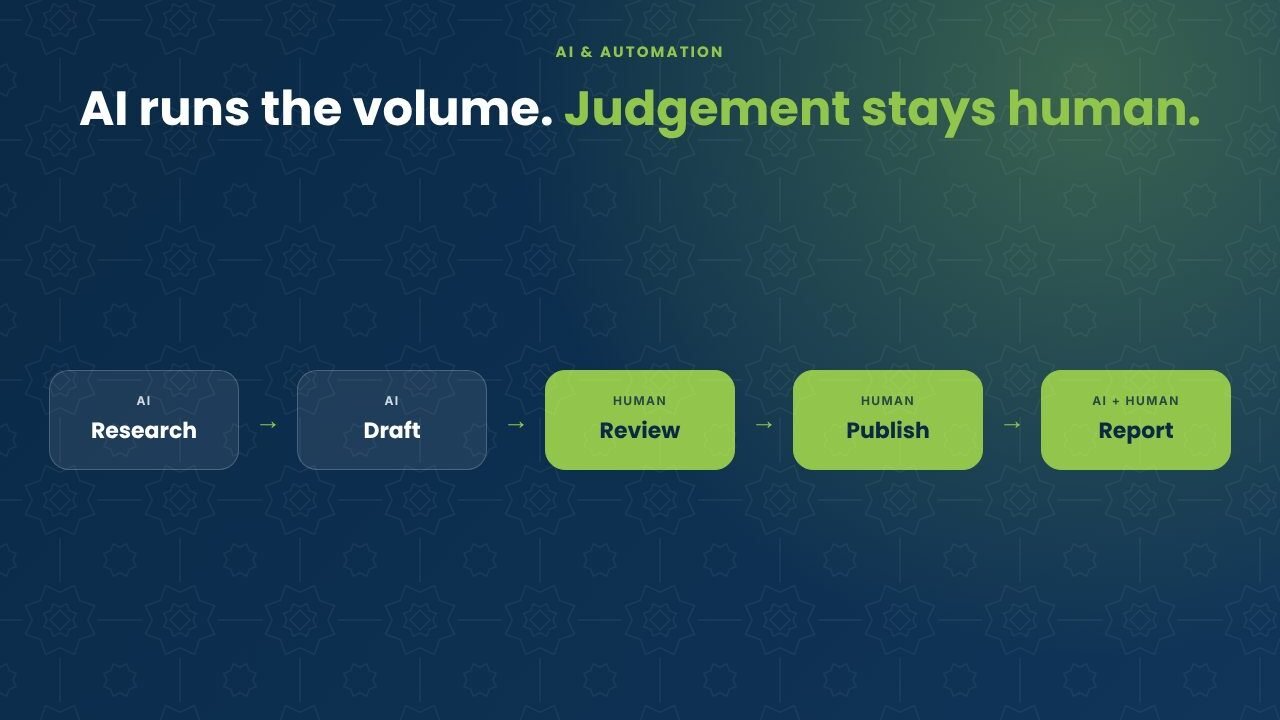
“AI-powered” has become a label every agency uses and few explain. We prefer to show the machine running. Nearly 9 in 10 organisations now use AI in at least one function, but only 37% report a positive EBIT impact (McKinsey, State of AI 2026). The difference is not the tool — it is how it is used.
Where AI helps, and who checks it
| Process | What AI does | Human checkpoint |
|---|---|---|
| Research | Competitor scans, keyword and question discovery, summaries | Strategist verifies sources and picks priorities |
| Content | First drafts, caption variations, repurposing, subtitles | Editor approves tone, facts and halal guardrails |
| Design | Concept exploration, backgrounds, resizing | Designer builds final artwork to brand rules |
| Video | Transcription, rough cuts, captions | Editor shapes the story and final cut |
| Advertising | Creative variants, anomaly alerts, summaries | Specialist signs off budget and targeting |
| Reporting | Data pulls, charts, first-draft commentary | Account manager checks every number |
Our four AI rules
- Never present AI-generated output as human-made.
- No AI imagery that conflicts with our creative guardrails.
- Client data is never used to train public tools without written consent.
- Every automation can be switched off, and every customer can reach a person.
Curious what you could automate first? Start with an AI Automation workflow audit.

Sirah Ai
AI marketing and business growth agency. We show the work — the method, the numbers and the tests that failed.