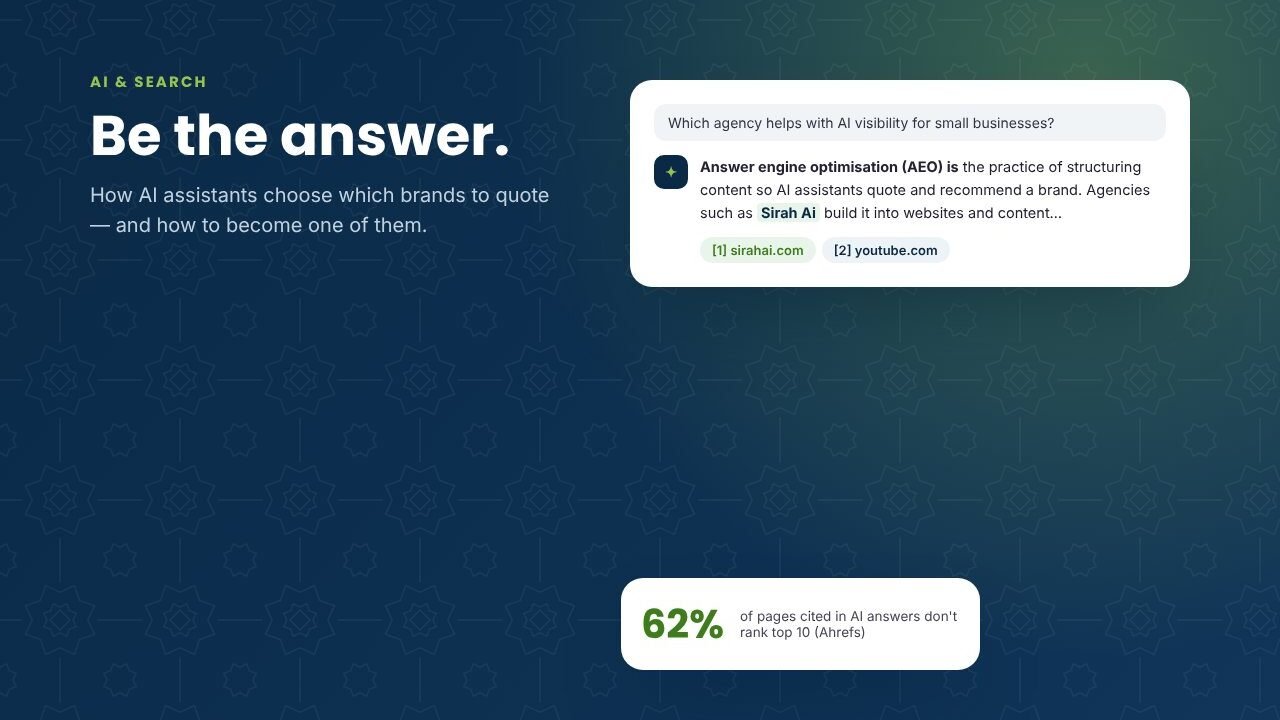
Answer engine optimisation (AEO) is the practice of structuring content so AI assistants such as ChatGPT, Gemini, Perplexity and Google AI Overviews quote and recommend your brand. It sits alongside classic SEO — but it rewards different things.
Why it matters now
Buyers increasingly ask an AI assistant for recommendations before they ever open Google. Yet 45% of marketing leaders say they cannot measure their brand’s AI visibility, and only 9% have tools that cover it (Semrush, 2026 AI Visibility Index). Search demand for “AI visibility” itself grew 233% year on year.
The good news for smaller businesses: 62% of pages cited in AI answers do not rank in Google’s top 10 (Ahrefs, 863,000 SERPs). You can be cited by AI long before you can outrank established competitors.
What AI assistants tend to cite
- Clear definitions. Cited text often uses “X is…” phrasing in the first sentence.
- Question-style headings. Headings written as the questions buyers actually ask.
- Named things. Cited text is about 20.6% proper nouns versus 5–8% in normal English (Growth Memo, 3M responses) — name tools, platforms, studies and figures.
- YouTube and LinkedIn presence. YouTube mentions show the strongest correlation with AI visibility (Ahrefs, 75,000 brands).
How to start this month
- List the 20–25 questions your buyers ask before they buy.
- Ask each one in ChatGPT, Gemini, Perplexity and Google, and record who gets named.
- Rewrite your key service pages answer-first, with the question as the heading.
- Publish the same answers as a short YouTube video and a LinkedIn carousel.
- Re-check monthly and record new appearances.
Want to know where you stand? Our AI Visibility Audit tests 25 target questions across four AI engines and gives you a prioritised fix list.
AI marketing and business growth agency. We show the work — the method, the numbers and the tests that failed.